

HoReCa Market Set to Reach USD 7.29 Trillion by 2035 Amid Digital Transformation and Sustainability Initiatives
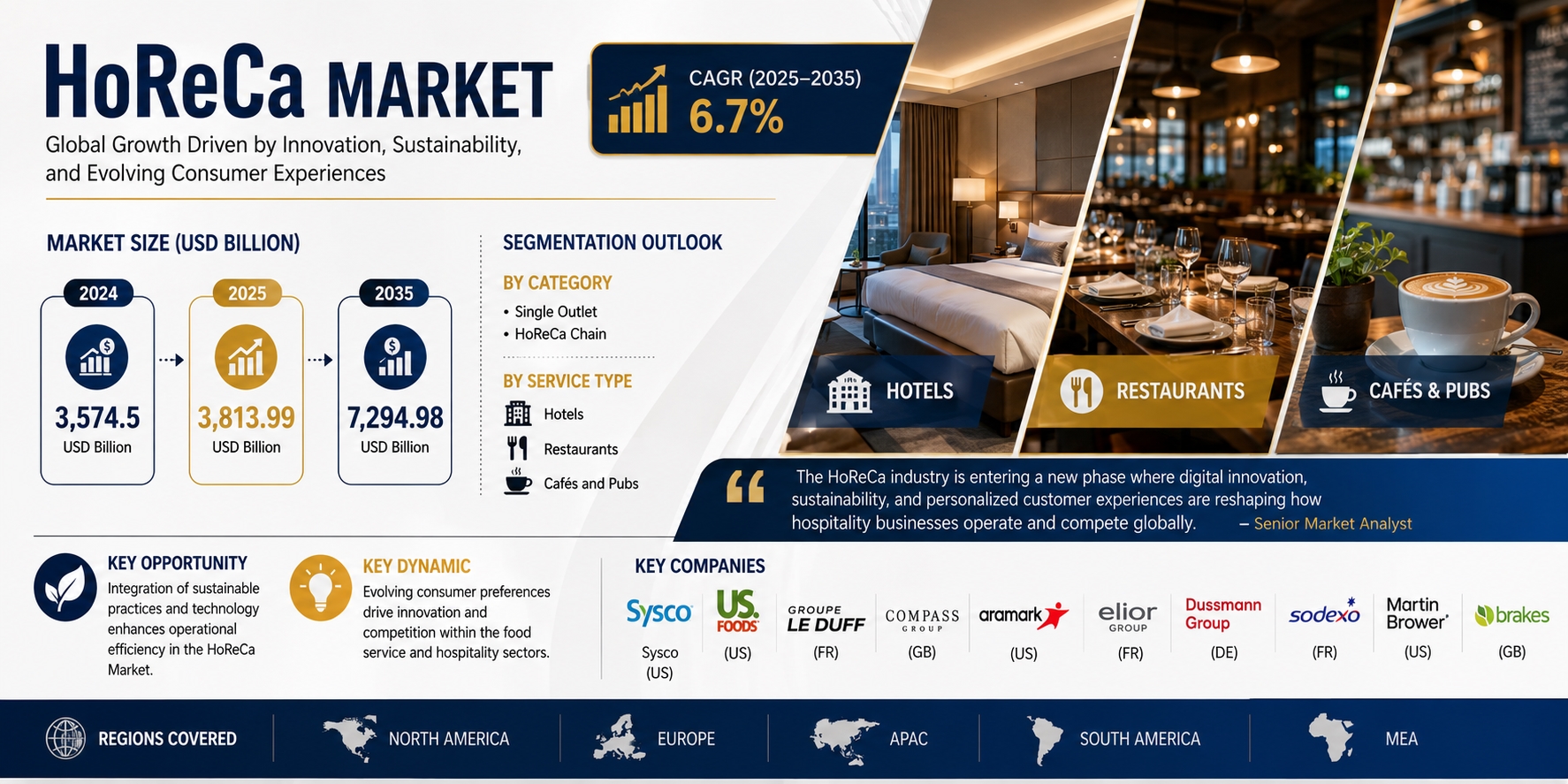
HoReCa Market
Global HoReCa Industry Witnesses Strong Momentum as Hotels, Restaurants, Cafes, and Pubs Embrace Technology-Driven Operations
The HoReCa industry is entering a new phase where digital innovation, sustainability, and personalized customer experiences are reshaping how hospitality businesses operate and compete globally.”
NEW YORK, NY, UNITED STATES, June 22, 2026 /EINPresswire.com/ -- The global HoReCa (Hotel, Restaurant, and Café/Catering) Market is experiencing a significant transformation as hospitality businesses adapt to changing consumer preferences, evolving dining habits, and increasing adoption of digital technologies. According to the Market Research Future analysis, the HoReCa Market was valued at USD 3,574.5 billion in 2024 and is projected to grow from USD 3,813.99 billion in 2025 to USD 7,294.98 billion by 2035, registering a CAGR of 6.7% during the forecast period.— Market Research Future (MRFR)
The market continues to benefit from rising tourism activity, urbanization, growing disposable incomes, and increased demand for diverse dining experiences. Hotels, restaurants, cafés, and pubs are increasingly investing in technology-enabled solutions, sustainable sourcing practices, and operational efficiency enhancements to strengthen customer engagement and improve profitability.
The HoReCa ecosystem plays a critical role in the global hospitality and food service industry by connecting suppliers, distributors, operators, and consumers. As customer expectations evolve, businesses across the sector are focusing on personalized experiences, digital ordering systems, contactless services, and environmentally responsible operations.
Hospitality Industry Enters a New Era of Consumer-Centric Innovation
Consumer behavior has undergone notable changes over the past decade. Modern travelers and diners increasingly seek convenience, quality, authenticity, and sustainability. This shift has encouraged HoReCa operators to redesign service models and introduce innovative offerings that align with emerging expectations.
Hotels are integrating smart technologies to streamline guest experiences, while restaurants are leveraging digital platforms to manage reservations, online ordering, and customer engagement. Cafés and pubs are expanding menu diversity and creating experiential environments that attract younger demographics.
The growing preference for convenience-based dining experiences has accelerated the adoption of mobile applications, digital payment systems, self-service kiosks, and artificial intelligence-powered customer support solutions. These technologies are helping businesses improve service quality while optimizing operational costs.
Industry participants are also embracing data analytics to better understand customer preferences and purchasing behavior. By utilizing actionable insights, businesses can tailor services, improve inventory management, and enhance customer retention strategies.
Sustainability Emerges as a Key Competitive Differentiator
Sustainability has become one of the defining themes shaping the future of the HoReCa Market. Consumers increasingly favor establishments that demonstrate environmental responsibility through sustainable sourcing, waste reduction initiatives, and energy-efficient operations.
Hotels are implementing green building practices and renewable energy systems, while restaurants and cafés are focusing on locally sourced ingredients, reduced food waste, and eco-friendly packaging solutions. These initiatives not only support environmental objectives but also strengthen brand reputation and customer loyalty.
Technology and sustainability are increasingly working together to improve operational efficiency. Smart inventory systems help reduce waste, while energy management solutions contribute to lower utility consumption. Such advancements are expected to create significant opportunities for market participants throughout the forecast period.
Get Full PDF Sample Copy of Report: (Including Full TOC, List of Tables & Figures, Chart) @ https://www.marketresearchfuture.com/sample_request/10535
Market Segmentation Analysis
By Category
Single Outlet
Single-outlet establishments continue to maintain a significant presence within the HoReCa Market. Independent restaurants, boutique hotels, local cafés, and neighborhood pubs often differentiate themselves through personalized service, unique menus, and strong community engagement.
These businesses frequently capitalize on local consumer preferences and niche market opportunities. Their flexibility allows them to respond quickly to changing trends and customer expectations.
Single-outlet operators account for a considerable share of hospitality establishments globally, particularly in emerging economies where family-owned businesses dominate the food service landscape. Growing consumer demand for authentic dining experiences, artisanal products, and locally sourced ingredients continues to support the expansion of independent operators. Additionally, digital ordering platforms and social media marketing have enabled smaller businesses to compete more effectively with larger chains by reaching broader customer audiences at relatively low costs.
HoReCa Chain
Chain-based operators represent a substantial portion of the global market due to their established brand recognition, operational consistency, and economies of scale. International and regional chains continue to expand through franchising, acquisitions, and strategic partnerships.
Large-scale operators often benefit from advanced supply chain management systems, standardized service protocols, and significant marketing resources, enabling them to compete effectively across multiple geographic regions.
The chain segment is expected to witness robust growth throughout the forecast period as major hospitality brands continue expanding into high-growth urban centers and emerging markets. Global chains are increasingly investing in loyalty programs, mobile applications, and AI-driven customer engagement tools to strengthen customer retention. Their ability to negotiate favorable supplier contracts and implement centralized procurement strategies also contributes to improved profitability and operational efficiency.
By Service Type
Hotels
The hotel segment remains a major contributor to overall market revenue. Growth in business travel, leisure tourism, and international mobility continues to support demand for accommodation services worldwide.
Hotels are increasingly investing in digital guest experiences, automated check-in systems, smart room technologies, and personalized hospitality services. These innovations help improve guest satisfaction while enhancing operational efficiency.
Luxury, upscale, and boutique hotel segments are particularly benefiting from demand for premium experiences and customized services.
The hotel industry is also benefiting from the recovery of international tourism and the growing popularity of staycations, wellness tourism, and experiential travel. According to industry trends, occupancy rates across major tourism destinations have shown steady improvement, encouraging hotel operators to expand room inventories and renovate existing properties. Sustainability certifications and eco-friendly accommodations are becoming increasingly important factors influencing booking decisions among travelers.
Restaurants
Restaurants represent one of the largest and most dynamic segments within the HoReCa industry. Consumer interest in diverse cuisines, experiential dining, and convenience-based food services continues to drive innovation across the sector.
Operators are expanding delivery services, adopting cloud kitchen models, and utilizing advanced customer relationship management platforms to improve competitiveness. Menu innovation and health-conscious offerings are also becoming important differentiators.
The restaurant segment continues to benefit from the rapid growth of online food delivery platforms and digital ordering solutions. Quick-service restaurants (QSRs), casual dining establishments, and fine dining venues are increasingly leveraging technology to streamline operations and enhance customer experiences. Rising demand for plant-based foods, organic ingredients, and functional beverages is further influencing menu development strategies across global markets.
Cafés and Pubs
Cafés and pubs continue to evolve as social and lifestyle destinations. Beyond food and beverages, these establishments increasingly serve as community gathering spaces, remote working environments, and entertainment venues.
Specialty coffee, premium beverage offerings, craft-focused menus, and unique customer experiences are helping cafés and pubs attract broader consumer demographics.
The segment is witnessing growing demand for premium coffee products, craft beers, artisanal beverages, and themed hospitality experiences. Many cafés are incorporating co-working spaces and digital connectivity features to attract professionals and students, while pubs are enhancing customer engagement through live entertainment, sports screenings, and experiential events. These evolving business models are contributing to sustained revenue growth across the segment.
Regional Market Insights
North America
North America remains one of the most mature and technologically advanced HoReCa markets globally. Strong consumer spending, widespread digital adoption, and a well-established hospitality infrastructure contribute to regional market performance.
The United States continues to lead the regional landscape, supported by extensive restaurant networks, hotel chains, and food service distributors. Investments in automation, sustainability, and customer experience enhancements are expected to support future growth.
The region accounts for a significant share of global HoReCa revenues, driven by high per-capita spending on dining and travel experiences. Canada and Mexico are also witnessing increased investments in hospitality infrastructure, tourism development, and food service modernization. The growing adoption of self-service technologies, contactless payments, and AI-powered customer engagement solutions is expected to further strengthen market growth across North America.
Europe
Europe maintains a strong position in the global HoReCa Market due to its rich hospitality traditions, thriving tourism sector, and extensive food service industry. Countries across the region continue to attract international visitors seeking cultural, culinary, and leisure experiences.
Sustainability initiatives and regulatory support for environmentally responsible practices are encouraging operators to modernize operations and adopt green technologies.
Major markets including Germany, France, the United Kingdom, Italy, and Spain continue to drive regional demand. Europe's strong café culture, established hotel industry, and growing focus on sustainable tourism contribute significantly to market expansion. Investments in energy-efficient facilities, waste reduction programs, and locally sourced food products are becoming increasingly common among hospitality operators throughout the region.
Asia-Pacific
Asia-Pacific is anticipated to remain one of the fastest-evolving regional markets throughout the forecast period. Rapid urbanization, growing middle-class populations, rising disposable incomes, and expanding tourism activity are contributing to market expansion.
Countries such as China, India, Japan, South Korea, and Southeast Asian nations are witnessing increased investments in hospitality infrastructure and food service operations. Digital-first consumer behavior is further accelerating industry modernization.
The region is expected to register one of the highest growth rates globally due to favorable demographic trends and expanding domestic tourism. China and India are emerging as key growth engines, supported by rising consumer spending and rapid expansion of organized food service chains. Additionally, increasing smartphone penetration and widespread adoption of digital payment systems are enabling seamless customer experiences across hospitality establishments.
South America
South America's hospitality and food service sector continues to develop alongside urban growth and tourism recovery efforts. Restaurants, hotels, and cafés are focusing on customer experience improvements and digital service integration to strengthen competitiveness.
Brazil, Argentina, Chile, and Colombia remain among the leading contributors to regional market growth. Rising tourism activity, expanding middle-income populations, and increasing investments in hospitality infrastructure are creating favorable conditions for industry expansion. Food delivery services and digital reservation platforms are also gaining traction across major metropolitan areas.
Middle East and Africa
The Middle East and Africa region is witnessing increasing investment in tourism, hospitality infrastructure, and entertainment projects. Major development initiatives, international events, and government-led diversification programs are supporting expansion across the HoReCa ecosystem.
Luxury hospitality remains particularly prominent in several Middle Eastern markets, while emerging African economies continue to create new opportunities for industry participants.
Countries such as the United Arab Emirates, Saudi Arabia, Qatar, and South Africa are attracting substantial investments in hotels, resorts, restaurants, and tourism-related developments. Large-scale projects associated with economic diversification strategies and international tourism campaigns are expected to drive long-term market growth. Furthermore, increasing urbanization and a growing young population across several African nations are contributing to rising demand for modern food service and hospitality offerings.
Competitive Landscape
The HoReCa Market is characterized by the presence of numerous global and regional participants competing across hospitality, food service, distribution, and catering segments.
Key companies operating in the market include:
• Sysco (US) – Recently expanded its digital ordering capabilities and strengthened supply chain efficiency initiatives to enhance customer service across foodservice channels.
• US Foods (US) – Continued investing in e-commerce platforms and value-added solutions while expanding product offerings for restaurant operators.
• Groupe Le Duff (France) – Advanced international expansion efforts through new bakery-café openings and strategic brand development initiatives.
• Compass Group (United Kingdom) – Focused on sustainable foodservice solutions and secured new contract wins across healthcare, education, and business sectors.
• Aramark (US) – Expanded its hospitality and facilities management portfolio while increasing investments in sustainability and operational innovation.
• Elior Group (France) – Strengthened its contract catering business through digital transformation programs and enhanced customer experience initiatives.
• Dussmann Group (Germany) – Continued expanding integrated facility management and foodservice operations across European markets.
• Sodexo (France) – Accelerated sustainability commitments and broadened its food and facilities management services through strategic partnerships.
• Martin Brower (US) – Enhanced logistics capabilities and supply chain technologies to improve distribution efficiency for quick-service restaurant clients.
• Brakes (United Kingdom) – Expanded its foodservice distribution network and introduced new product ranges focused on sustainability and customer demand.
These organizations are actively pursuing strategic initiatives including digital transformation, service portfolio expansion, sustainability programs, geographic expansion, mergers and acquisitions, and operational optimization efforts.
Partnerships with technology providers and investments in supply chain modernization are becoming increasingly important as companies seek to improve efficiency and maintain competitive advantages.
Future Outlook
The global HoReCa Market is expected to undergo substantial transformation through 2035 as operators continue adapting to changing consumer expectations and technological advancements.
Key trends expected to influence future industry development include:
• Increased adoption of artificial intelligence and automation
• Expansion of contactless and digital service models
• Greater emphasis on sustainability and responsible sourcing
• Rising demand for personalized hospitality experiences
• Growth of data-driven decision-making capabilities
• Enhanced integration of supply chain technologies
• Continued expansion of experiential dining concepts
As businesses balance innovation, customer satisfaction, and operational efficiency, the HoReCa industry is positioned to remain a cornerstone of the global hospitality and food service economy. Companies that successfully combine technology adoption, sustainability initiatives, and customer-centric strategies are likely to be well-positioned for long-term success.
Discover Related Research Reports By Market Research Future:
Cafe Bars Market
https://www.marketresearchfuture.com/reports/cafe-bars-market-26218
Quick Service Restaurants (QSR) Market
https://www.marketresearchfuture.com/reports/quick-service-restaurants-qsr-market-10541
Beach Hotels Market
https://www.marketresearchfuture.com/reports/beach-hotels-market-24111
Sagar Kadam
Market Research Future
+1 628-258-0071
email us here
Visit us on social media:
LinkedIn
Facebook
X
Legal Disclaimer:
EIN Presswire provides this news content "as is" without warranty of any kind. We do not accept any responsibility or liability for the accuracy, content, images, videos, licenses, completeness, legality, or reliability of the information contained in this article. If you have any complaints or copyright issues related to this article, kindly contact the author above.
